Get your cybersecurity risk heatmap in under
10 minutes

See where your organization is most exposed and identify the security improvements that will have the greatest impact.

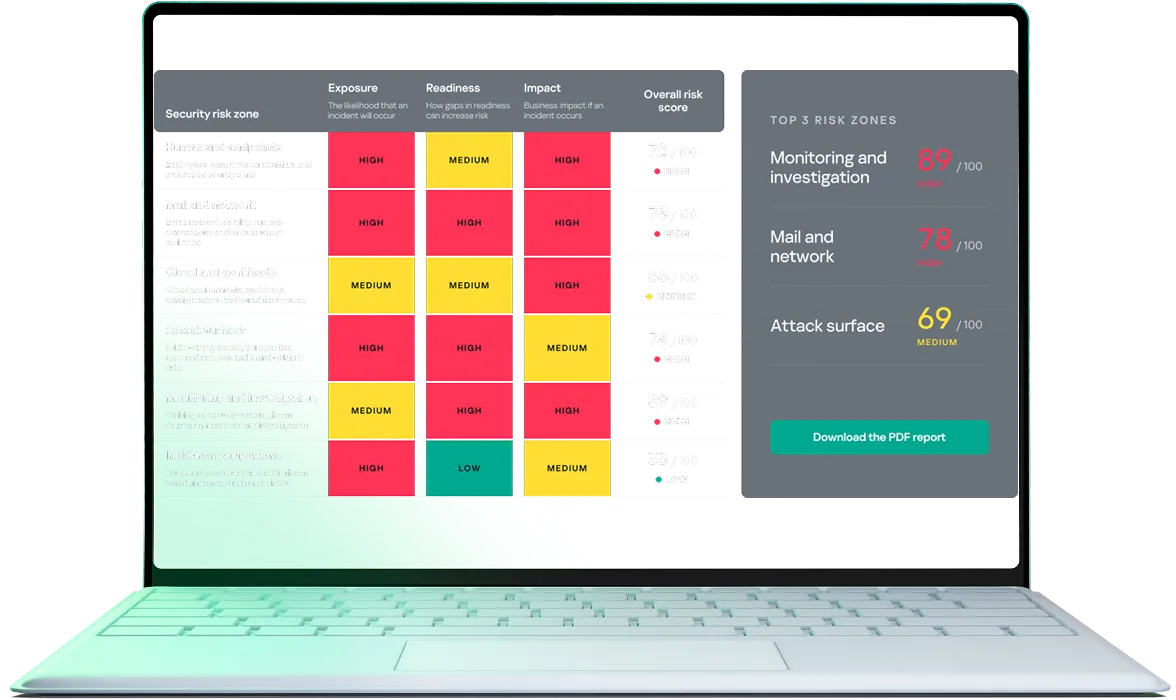
Your personalized results include an overall risk index, key focus areas, and practical recommendations to strengthen resilience and improve readiness.

Cybersecurity risk heatmap preview

Immediate personalized results

Actionable recommendations

Free PDF report

Hidden security gaps often become visible only after an incident

Security teams manage countless tools, alerts and operational tasks every day. Yet gaining a clear view of the organization’s overall security posture remains a challenge.

The key questions are:

Which areas create the highest business risk?

Which improvements should be made first?

How should limited resources be prioritized?

The Kaspersky cybersecurity risk heatmap

transforms complex security information into a clear visual overview, helping you focus on what matters most

What you get

Laptop showing cybersecurity dashboard

Personalized risk heatmap

See your performance across key cybersecurity risk zones

Overall risk index

Get a clear view of your current cybersecurity exposure

Key focus areas

Identify the domains that require the most attention

Tailored next steps

Receive practical recommendations to help prioritize security improvements

Downloadable PDF report

Save your results and share them with stakeholders and decision-makers

The assessment highlights potential weaknesses before they develop into larger operational or business problems

Around 15 questions

The exact number depends on your infrastructure and security priorities

Under 10 minutes

The assessment is designed to be completed quickly, with no technical preparation required

Immediate results

You will receive your risk heatmap, overall risk index, top priority areas and downloadable PDF report

Key cybersecurity risk zones covered

The Kaspersky cybersecurity risk heatmap uses a risk-based scoring model to show where your organization may need to focus first

Human and endpoints

Employees, awareness, credentials and protection of endpoints

Mail and network

Email, network visibility, remote connectivity and infrastructure resilience

Cloud and workloads

Cloud environments, workloads, configurations and container security

Attack surface

Public-facing assets, third parties, exposed services and brand-related risks

Monitoring and investigation

Visibility of security events, threat detection, response and investigation

Incident management

Response processes and tools, threat containment and team readiness

How it works

Your heatmap is built across the areas that define how exposed your organization is, how prepared it is to respond, and where security improvements should be prioritized

Your result is based on three factors:

Exposure

The likelihood that a threat or incident will occur

Readiness

How gaps in readiness can increase risk in each risk zone

Impact

The potential business impact if an incident occurs


0%


molecule
arch

molecule
arch

molecule
arch